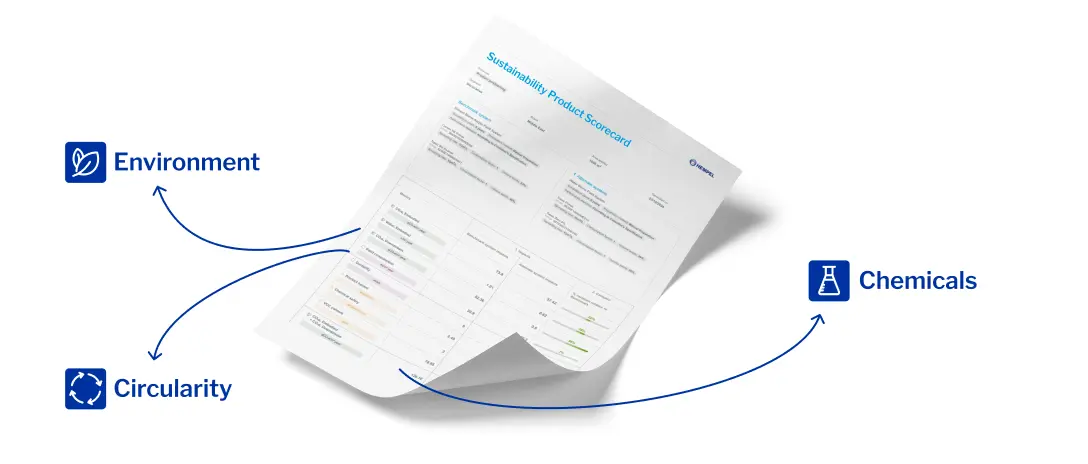
Hempel Sustainability Product Scorecard
Get a structured view of selected environmental impact and chemical indicators for relevant Hempel products and coating systems.
The Hempel Sustainability Product Scorecard brings together selected environmental, resource-use and chemical indicators for Hempel products and coating systems.
It is designed to support product assessment and comparison alongside technical performance and application requirements. It is not a certification, sustainability label or complete lifecycle assessment. Hempel co-developed the Scorecard with the global sustainability consultancy, Anthesis. They advised on the methodology, and we developed the individual indicators based on standards, databases and calculation methods as per below.
Interested in learning more? The section below provides detailed insights into the Hempel Sustainability Product Scorecard, including the individual metrics and their calculation methods.

Environment
Product Carbon Footprint measures greenhouse-gas emissions generated during the different stages of a product’s lifecycle. The data can support assessment of product-related emissions within the defined boundary.
Water consumption is also one of the selected indicators.
-
CO₂e, Embodied
Embodied CO2-equivalent emissions (CO2e) include all carbon emissions from Hempel’s side. We show combined CO2e data from raw materials, in-bound transport and product manufacturing for each product.
- Unit: g CO2e/m2 (grams of emitted CO2e per m2 of product per year, when applied at the specified Dry film thickness). The lower the number, the better.
- Calculation method: Using a lifecycle assessment methodology and Global Warming Potential indicator (E.F. 3.1) characterization factors.
- Primary company-specific data is used for manufacturing processes
- Secondary data from the Raw Materials LCI Database for the European Coatings and Printing Ink Industries (CEPE v4.0) is used for raw materials
- Secondary data from the Department for Energy Security and Net Zero (formerly DEFRA) is used for in-bound transportation
- Primary company-specific data is used for manufacturing processes
- Unit: g CO2e/m2 (grams of emitted CO2e per m2 of product per year, when applied at the specified Dry film thickness). The lower the number, the better.
-
Water, Embodied
Fresh water is an increasingly scarce resource. As a result, water consumption is now a key measure in sustainability performance. For each product, we show combined water consumption data from raw material extraction/production and product manufacturing.
- Unit: l/m2/year (litres of water consumed per m2 of product per year, when applied at the specified dry film thickness). The lower the number, the better.
- Calculation method: Using a lifecycle assessment methodology.
- Primary company-specific data is used for manufacturing processes
- Secondary data from EcoInvent (v3.7) database is used for raw materials
- Primary company-specific data is used for manufacturing processes
- Unit: l/m2/year (litres of water consumed per m2 of product per year, when applied at the specified dry film thickness). The lower the number, the better.
-
CO₂e, Downstream
Downstream CO2-equivalent emissions (CO2e) include carbon emissions related to the energy used during surface preparation and application as well as any volatile organic compounds (VOC) emitted during and after application of product.
- Unit: g CO2e/m2/year (grams of emitted CO2e per m2 of product per year, when applied at the specified dry film thickness). The lower the number, the better.
- Calculation method: Using a lifecycle assessment methodology.
- Secondary data from literature for industry average emissions from preparation and application processes is used
- Emissions from VOC evaporation calculated using the carbon content of xylene as representative average of all VOCs in a product
- Secondary data from literature for industry average emissions from preparation and application processes is used
- Unit: g CO2e/m2/year (grams of emitted CO2e per m2 of product per year, when applied at the specified dry film thickness). The lower the number, the better.

Circularity
-
Paint consumption
Lower paint consumption with the same performance level, can reduce material use. We display paint consumption data as the amount of paint required for the system to achieve the required performance.
- Unit: ml/m2/year (litres of paint required per m2 of product per year, when applied at the specified dry film thickness). The lower the number, the better.
-
Durability
For a coating system, durability is key. Selected technologies with focus on high durability can extend asset lifetime and reduce maintenance, leading to cost and material savings and emission reductions over the asset’s entire lifecycle compared with reference systems under specified conditions.
We show durability data as the length of a time a painted asset should remain in service with the correct maintenance.- Unit: Years. The higher the number, the better.

Chemicals
Due to growing regulations and awareness, customers increasingly demand lower volatile organic compound (VOC) and biocide levels. We have made VOC and biocide reduction a key priority and therefore showcase the quantity of these in our solutions.
-
Product hazardWe assess the chemicals in our products using hazard classifications according to the Globally Harmonized System of Classification and Labelling of Chemicals (GHS).
-
Chemical safetyThe chemical safety score is based on the product hazard combined with the applicator type (consumer/professional), application location and method (spray/brush & roller).
-
VOC content
Volatile organic compounds (VOCs) can negatively impact air quality and human health. Many countries have clear guidelines and/or regulations for the amount of VOC allowed in paint products. If this is unavailable, we use the EU legislative VOC for the relevant product (except products applied in North America).
- Unit: g/m2 (grams of VOC per m2 of product, when applied at the specified dry film thickness). The lower the number, the better.
-
Biocides content
Biocides can negatively impact the environment, but they are a tool for protecting ships and marine structures from biofouling. Many countries regulate biocidal products to minimize environmental risks and all Hempel antifouling coatings comply with any relevant national or regional regulation.
- Unit: g/m2 (grams of biocides present per m2 of product, when applied at the specified dry film thickness). The lower the number, the better.
What sustainability support do you need?
Whether you need a quick overview of a product’s carbon footprint or a detailed sustainability report, we’ve got you covered.

Sustainability metrics in our Coating System Selector tool
Our online Coating System Selector tool, helps you identify Hempel coating systems that match your specified technical and product-data requirements.
The tool includes four key sustainability metrics (Carbon Footprint, paint consumption and VOC content), so you can include sustainability in your product search, right from the start.
Request a Hempel Sustainability Product Scorecard for your products or coating systems.
Please contact your Hempel representative to get a Sustainability Product Scorecard for your product or coating system.