Interview with World Pipelines Magazine: Unveiling Hempatherm IC
Hempel’s very own David Hunter, Segment Development Manager for CUI/High Heat & Insulation, recently sat down with World Pipelines Magazine for their July issue to talk about our entrance to the insulation coatings market.
The insulation coatings system, called Hempatherm IC, boasts one of the market’s highest film build capabilities, leading thermal performance versus other insulation coatings, while preventing Corrosion Under Insulation (CUI).
World Pipelines: Thanks for joining us, David. Could you start out by telling us a little bit about the inspiration and innovation behind Hempatherm?
David Hunter: Absolutely. Insulation coatings are not new. In fact, variations have been on the market for over 25 years. Thermal Insulation Coatings’ (TICs) ability to mitigate CUI, their thermal performance stability, and long, maintenance-free service lives are well understood. These features are even recognised by API. The challenge with the technology is that the majority of the competing TICs cannot be applied thickly enough to rival the performance of conventional mechanical insulation alternatives. Hempatherm addresses that problem, making the addressable market much larger for TICs - and Hempatherm in particular.
The second part is that we listened to our customers, who are all interested in more sustainable operations. A typical process for monitoring CUI at facilities is to remove (and dispose of) existing mechanical insulation, inspect the surfaces, and then replace them. This obviously creates a lot of waste that goes straight to landfill, and this amount of waste has been identified as a top contributor to the overall waste stream of a facility. TICs can help in solving this problem.
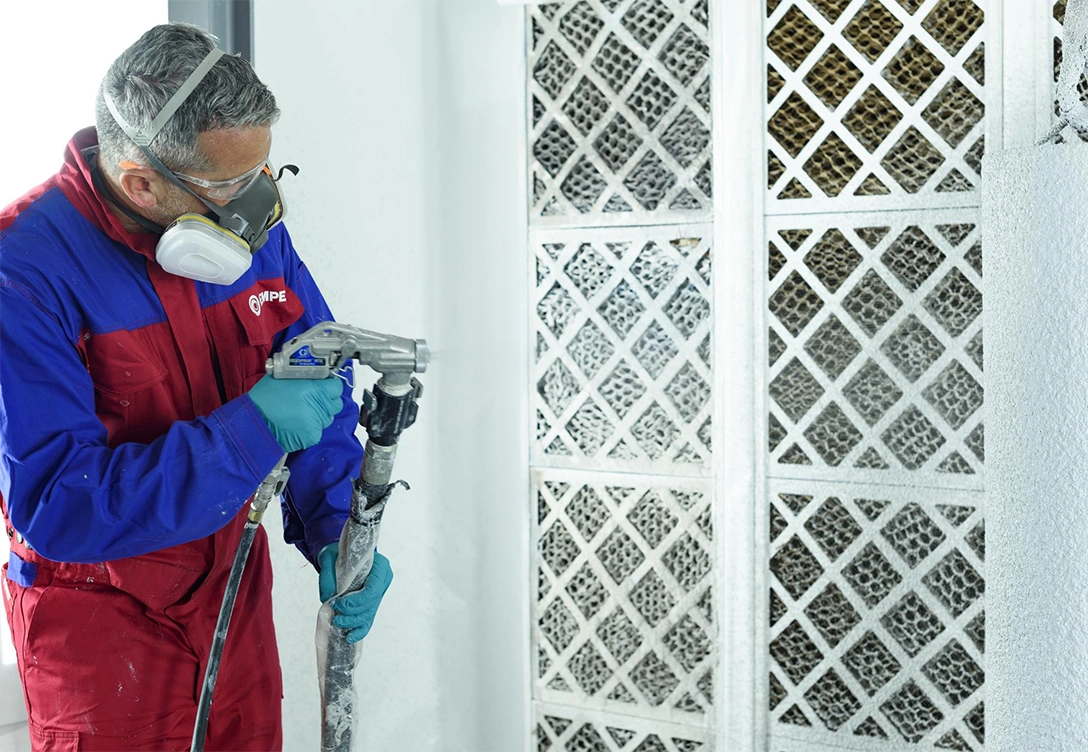
Hempatherm offers a comprehensive suite of features, designed to meet the diverse needs of our customers, but also of our applicators working in the field. Notably, it provides high film build per coat, which reduces application labour costs. The products are non-hazardous, and zero VOC, which minimises worker exposure to hazardous solvents and chemicals. The Hempatherm system is non-flammable, which means that it can be applied on hot surfaces up to 150°C (300°F), without shutting down operations.
When it comes to CUI, Hempatherm’s operation range almost exactly covers the temperature range that is characterised by CUI, from -25°C up to 177°C (350°F). Additionally, the system can be used for personal protection from burns, while also effectively preventing solar heat gain, thereby contributing to energy conservation.

World Pipelines: What sets Hempatherm apart from traditional mechanical insulation systems?
David Hunter: Great question. What truly distinguishes Hempatherm are two things: Hempatherm’s ability to stop CUI and its long-term durability. All traditional mechanical insulation systems have seams that allow water to enter, thereby reducing the insulation’s effectiveness and thermal performance – and even if the traditional insulation is hydrophobic, water can still get behind it. Hempatherm is seamless, hydrophobic, and bonded directly to the substrate, which means that the thermal performance stays constant for Hempatherm’s service life, while simultaneously preventing CUI.
Secondly, traditional mechanical insulation uses a jacket as its primary weather barrier. The jacket is most often made out of thin metal, which is not very impact resistant. It cannot be stepped or walked on, and damage to the jacketing is often characterised as a primary reason for water ingress. The Hempatherm system has a very high impact resistance and a 15-year weathering durability testing, with no water ingress, even if the primer is damaged during installation. The product is designed for atmospheric service, but was also shown to handle intermittent immersion in water.
World Pipelines: That’s great! You also mention how the Hempatherm system contributes to energy conservation and operational efficiency. Can you tell us more about that?
David Hunter: Yes, that’s true; Hempatherm is engineered with energy conservation in mind. The system is powered by aerogel technology, which gives it a low thermal conductivity, making it a good insulator, coupled with a low permeability acrylic resin. Hempatherm does not hold water to any significant degree, so the thermal conductivity is not compromised, even in intermittent immersion. If you stop water ingress, you can stop CUI, and thereby improve the safe operation of any facility, and any costs of dealing with leaks. Ultimately, this promotes energy efficiency and enhances overall operational performance.
World Pipelines: What do you envision for the future of insulation coatings technology?
David Hunter: As industries continue to prioritise efficiency and sustainability, the demand for advanced insulation solutions will only grow. We foresee insulation coatings technology playing a pivotal role in this evolution, offering not only enhanced performance, but also greater cost competitiveness and environmental sustainability. With innovations like Hempatherm leading the way, the future of insulation coatings technology looks promising indeed.
World Pipelines: Thank you, David, for sharing your insights into Hempel's Hempatherm insulation coatings solution.